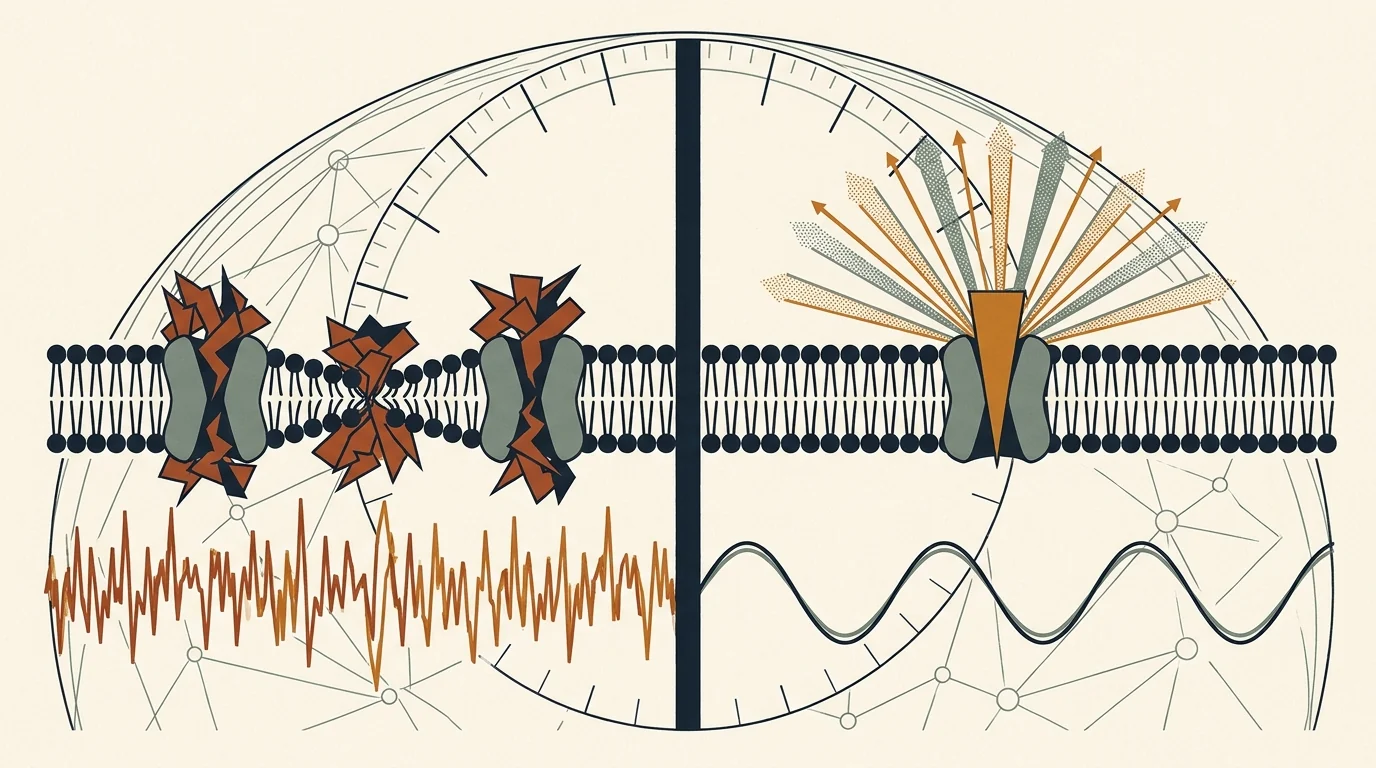
Misfolded tau quieted the molecular brakes inside locus coeruleus neurons, sending them into hyperactive firing states that a Kv7 ion channel opener successfully reversed.
Decades before Alzheimer’s pathology spreads across the cerebral cortex, misfolded tau proteins take root inside the locus coeruleus, a dense brainstem node that sprays noradrenaline across the brain to orchestrate wakefulness and network attention. Writing in bioRxiv, researchers probed how this early tau accumulation corrupts the electrical machinery of these crucial cells using P301S transgenic mice and wild-type animals injected with synthetic human tau fibrils. The team found that young mice bearing pre-tangle tau suffered a severe loss of low-threshold potassium current density. Stripped of the outward positive charges that normally reset membrane voltage after an action potential, the neurons lapsed into persistent overexcitation. Single-cell RNA profiling demonstrated that this bioelectric voltage collapse tracked a drop in the transcription of key potassium pore genes, including Kcnq3 and Kcnd1, alongside the nuclear accumulation of the transcriptional repressor REST. When the researchers dosed animals with retigabine, a drug that forces open Kv7 potassium channels, the treatment reinstated the missing outward currents, quieted runaway firing, and curtailed the spread of AT8-positive tau aggregates throughout the locus coeruleus.
The results frame membrane potential instability as an active engine of early tau pathology rather than a quiet byproduct of cellular death. By proving that mechanical opening of Kv7 pores restores voltage control and shields tyrosine hydroxylase-positive noradrenergic neurons from degradation, the study establishes ion-channel stabilization as a target for early therapeutic intervention. Because these bioelectric dynamics were mapped exclusively in rodent tissues and cultured cells, clinical trials must determine whether tuning Kv7 channels can safely stem neurological decline or modify cognitive outcomes in human populations.
Key takeaways
- Misfolded tau diminishes low-threshold potassium currents, forcing locus coeruleus noradrenergic neurons into relentless baseline firing.
- Single-cell sequencing ties early tau pathology to down-regulated Kcnq3 and Kcnd1 expression alongside heightened REST nuclear activity.
- Activating Kv7 channels with retigabine restores outward potassium fluxes, quieting overactive neurons and diminishing regional tau accumulation.
Source
Reported from Early locus coeruleus tauopathy features potassium channel dysfunction and is attenuated by Kv7 activation (bioRxiv neuroscience, genetics, physiology).
Evidence note: These experiments took place entirely within transgenic mice and isolated cellular preparations, meaning Kv7 channel activation remains an unproven therapy in human patients.