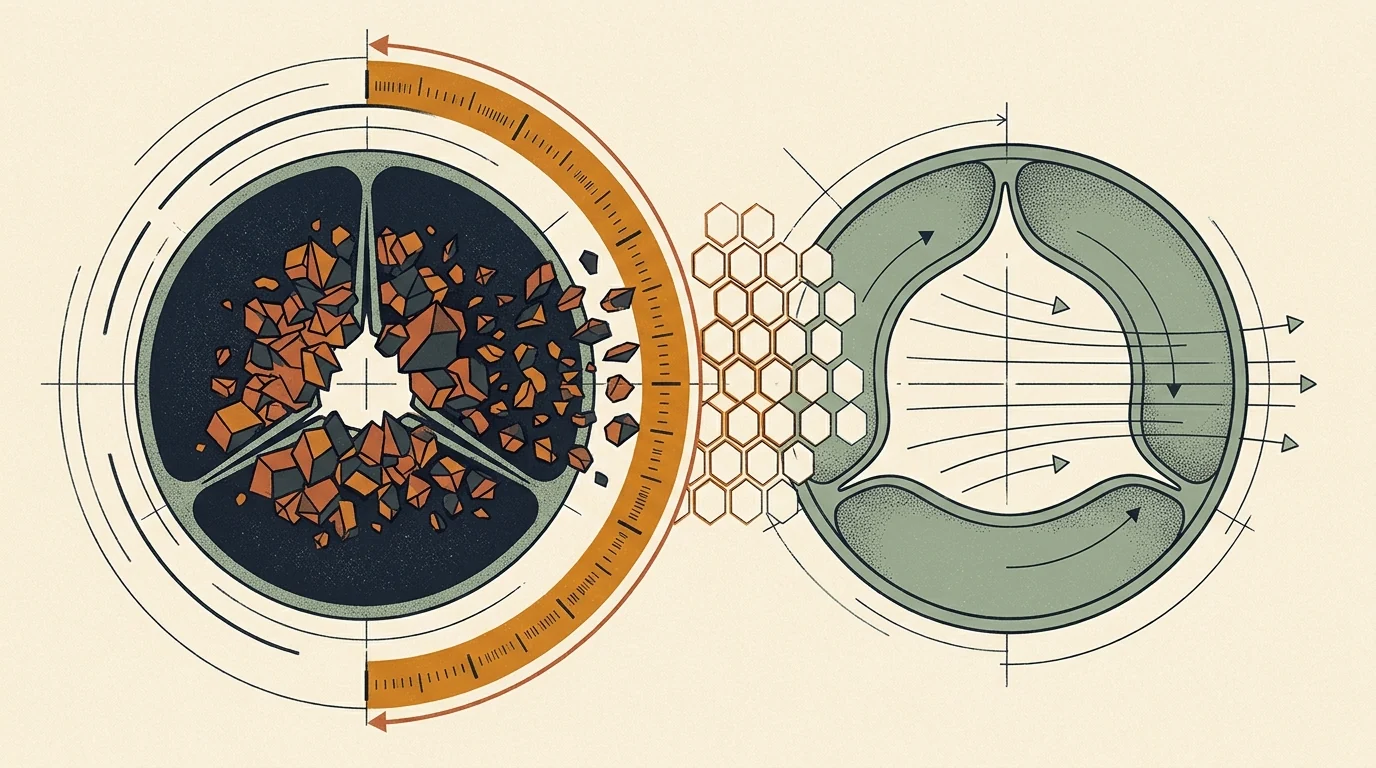
Cellular senescence drives the fibrotic remodeling and calcification of heart valves, pointing toward senolytic clearance as a unifying therapeutic strategy.
Calcific aortic valve disease stands as the most prevalent valvular heart disease in Western countries, yet no pharmacological therapy has ever modified its natural history. Once dismissed as a passive wear-and-tear process of mineral accumulation, the disease is now understood as an actively regulated cellular failure driven by endothelial dysfunction, chronic inflammation, and dysregulated mineral metabolism. These upstream disruptions converge on cellular senescence, locking resident valve cells into a permanent state of arrest where they secrete pro-inflammatory signals that accelerate fibrotic tissue remodeling and pathological mineralization. Past clinical trials testing lipid-lowering agents, renin-angiotensin system inhibitors, bone resorption inhibitors, vitamin K, and nitric oxide modulators have repeatedly failed to halt this destructive cascade in prospective randomized trials.
Emerging biological frameworks suggest that clearing these arrested cells could disrupt the mechanical loops driving leaflet calcification. Preclinical investigations show that senolytic drugs eliminate senescent cells and reduce tissue calcification in hypercholesterolemic vascular models, establishing a compelling rationale to test similar clearance strategies on heart valves. However, moving this approach from concept to human treatment requires overcoming historical shortcomings in trial design and mechanistic patient selection, as current evidence rests entirely on vascular models rather than direct human clinical demonstrations.
Key takeaways
- Calcific aortic valve disease progresses through active endothelial dysfunction, chronic inflammation, and mineral dysregulation rather than passive wear.
- Cellular senescence acts as a central mechanism driving the fibrotic remodeling and osteogenic calcification of heart valve leaflets.
- Preclinical vascular models demonstrate that senolytic therapies successfully clear senescent cells and reduce pathological tissue calcification.
Source
Reported from Cellular senescence in calcific aortic valve disease: are we ready for senolytic therapy? (PubMed).
Evidence note: Current evidence for senolytic clearance is derived from preclinical vascular and hypercholesterolemic models rather than direct human clinical trials.