
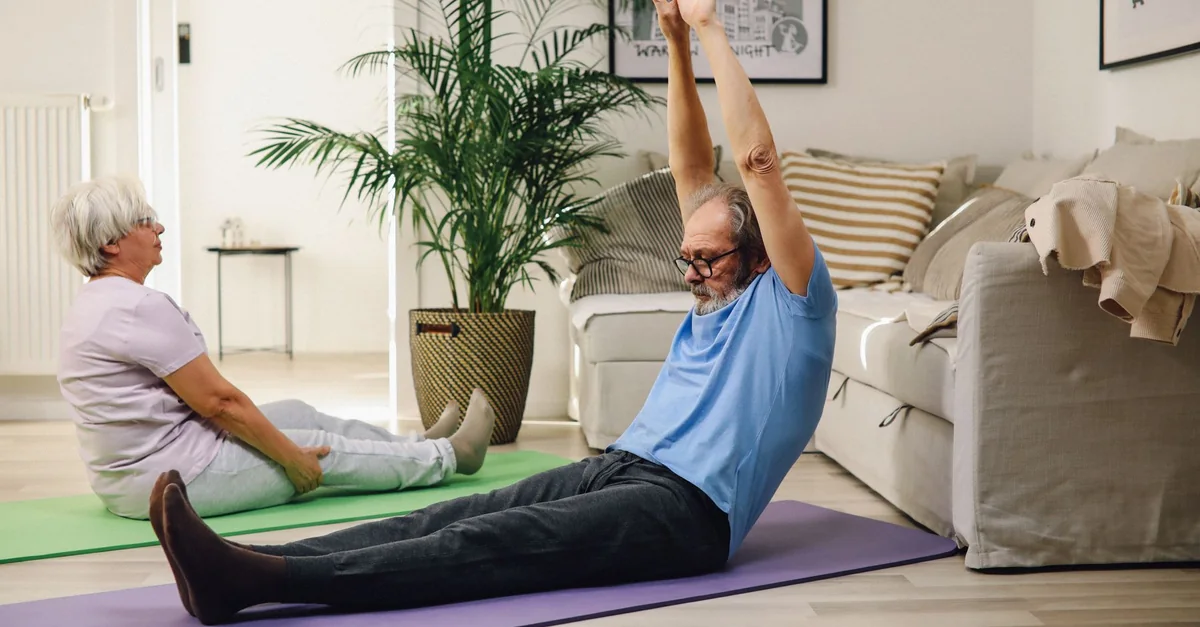
New research suggests a brief daily resistance exercise routine can improve strength and balance in older adults. Here’s what the study found—and what it doesn’t prove.
Why this matters
For many older adults, the idea of a lengthy workout can feel overwhelming. Time, discomfort, and uncertainty about proper technique often get in the way. Yet mobility loss is a serious concern: reduced strength and balance are linked to falls, which are a leading cause of injury and death among people over 65.
This new study from Penn State College of Medicine offers a simpler possibility. Instead of long sessions, just four minutes of daily resistance exercise—like push-ups, chair stands, and stair stepping—led to measurable improvements in strength and balance over 12 weeks. The findings suggest that consistency and simplicity may matter more than duration.
That’s a hopeful message for anyone who has felt that exercise is out of reach. It also points to a practical way to support independence, which is central to quality of life as we age.
What the study found
The research, published in PLOS One, followed 97 adults aged 65 and older, with an average age of 74. Participants were randomly assigned to either a four-minute daily routine called FAST-2 or to continue their usual activities. At the start, they were quite inactive, averaging only about 18 minutes of exercise per week.
The FAST-2 routine included four exercises: push-ups (against a wall or countertop), chair stands, two-arm rows with resistance bands, and stair stepping. Each movement was done for 30 seconds, followed by 30 seconds of rest, totaling four minutes. Participants could adjust the exercises to their comfort level, and they received virtual guidance.
After three months, those in the exercise group showed clear gains. They completed an average of 4.2 more repetitions in a 30-second chair stand test, improved one-leg balance time by 3.6 seconds, and reduced the time needed to stand up repeatedly by 2.3 seconds. They also stuck with the routine well, completing it on 81% of days.
How to interpret the results
These improvements may sound modest, but they reflect real-world function. Being able to rise from a chair more easily, balance longer on one leg, and move faster can make daily tasks safer and more manageable. The lead author, Christopher Sciamanna, notes that such indicators predict future risk of falling, difficulty walking, and even nursing home admission.
However, this is a single study with limitations. The sample size was small, and all participants had internet access, which may not represent everyone. The study lasted only 12 weeks, so we don’t know if the gains will persist. Also, the routine was not compared to longer workouts, so we can’t say it’s superior—only that it appears effective.
It’s also important to note that the study did not measure falls directly. While improved balance and strength are linked to lower fall risk, this research does not prove that the routine prevents falls or nursing home stays. Those outcomes would require longer, larger studies.
Practical next steps
If you’re considering a short daily routine, the key is to start where you are. The exercises in the study were designed to be adjustable: push-ups against a wall, chair stands with hand support, and using a resistance band for rows. You don’t need a gym or special equipment.
Before beginning any new exercise program, it’s wise to check with your healthcare provider, especially if you have health conditions or concerns. They can help you choose movements that are safe for you.
The study’s message is encouraging: small, consistent efforts can lead to meaningful change. Even a few minutes a day might help you maintain the strength and balance that support independence. As Sciamanna puts it, “Exercise is the key to freedom.”
Three things to remember
- Four-minute daily routine improved chair stand and balance tests.
- Participants completed exercises on 81% of days.
- Study was small and short; more research needed.
How to interpret it
Historical Biophysics & Lineage
The Penn State study’s four-minute daily routine (push-ups, chair stands, stair stepping) activates the same neuromuscular and musculoskeletal pathways identified by Fiatarone Singh’s FICSIT trial and Hill’s muscle physiology. Chair stands and stair stepping are closed-chain resistance exercises that load the quadriceps, gluteals, and calf muscles, stimulating mechanotransduction pathways (e.g., mTOR signaling) that promote muscle protein synthesis and hypertrophy. These movements also challenge the vestibular, proprioceptive, and visual systems, improving postural control and balance. The brevity of the routine leverages the principle of high-intensity interval training (HIIT) applied to resistance exercise: short bursts of near-maximal effort recruit high-threshold motor units (as per Henneman’s size principle, which Hill’s work informed), leading to rapid neural adaptations and increased muscle strength. This aligns with Fiatarone Singh’s evidence that even low-volume, high-intensity resistance training yields significant functional gains in older adults, and with Hill’s demonstration that muscle power output is optimized by brief, forceful contractions rather than prolonged submaximal activity.
Source
This analysis is based on Four-minute daily exercise boosts strength and mobility in older adults - The Brighter Side of News from The Brighter Side of News. Read the original report for full context.
Health note: This article is based on a single study with limitations. It does not constitute medical advice. Consult your doctor before starting any exercise program.